製品紹介
チタン管 · 溶接管 Gr.1 / TR270C / TA1
チタン管
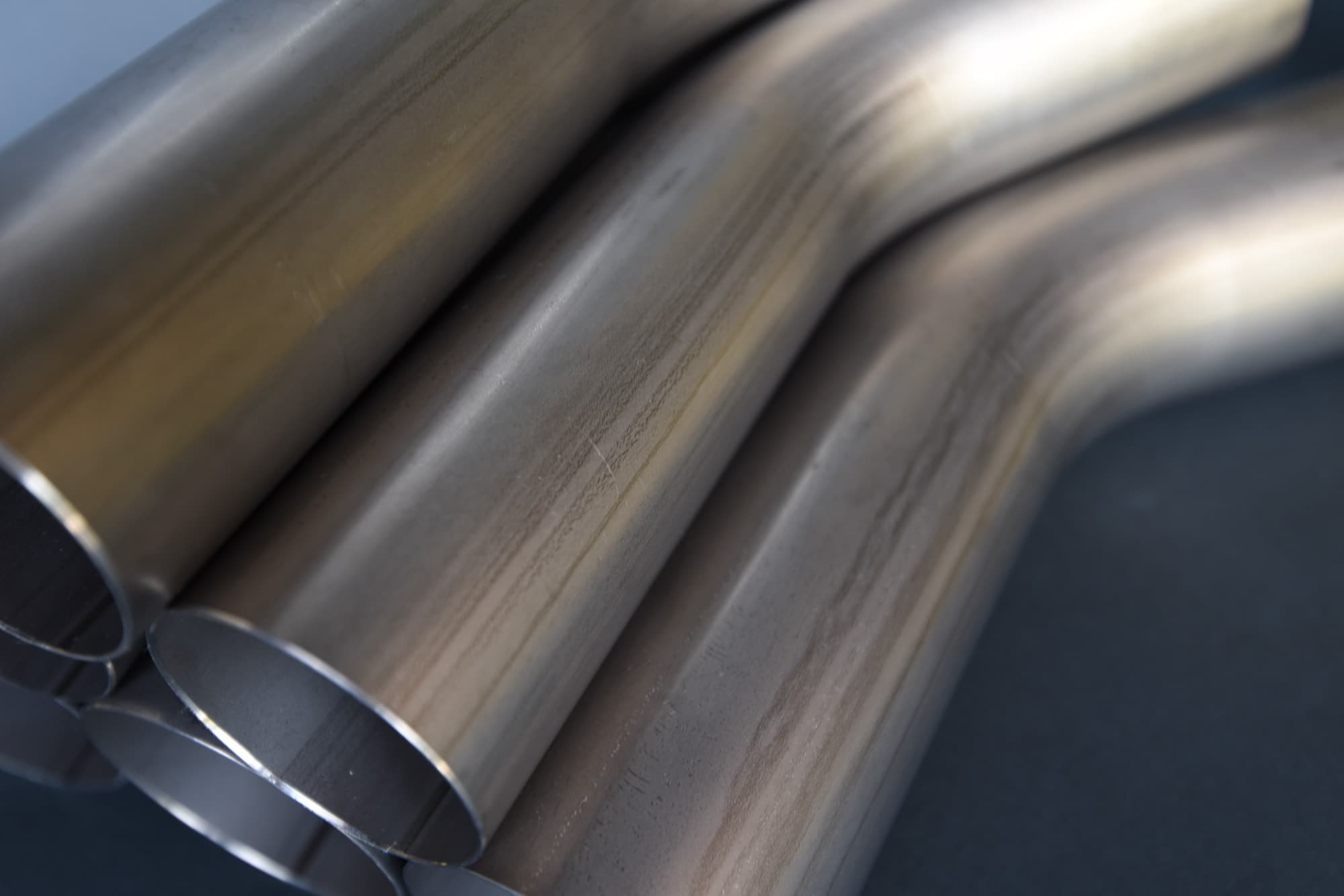
Welded titanium tube is made from cold-rolled thin sheet coil (titanium strip). The strip width is set to the circumference of the finished tube OD minus the width required for the weld seam. After this strip is continuously roll-formed, it is TIG-welded into the finished product. The OD range produced is 10–50 mm with a wall thickness of 0.3–2 mm. After welding, no hammering of slag or grinding is required and the surface is very smooth. It can also undergo secondary processing such as expansion and bending, with almost no difference from seamless tube.
Weld quality is mainly influenced by temperature, pressure, diffusion time and surface roughness. The higher the welding temperature, the faster the atomic diffusion. The welding temperature for titanium tube is generally 0.5–0.8 times the melting point of the material.
Depending on the material type and the required joint quality, diffusion welding can be carried out in vacuum, under a protective gas or under flux, of which vacuum diffusion welding is the most widely used. To speed up the welding process, reduce surface-roughness requirements, or prevent harmful structures forming in the joint, an interlayer material of specific composition — around 0.01 mm thick — is often added between the welding surfaces.
Diffusion welding uses relatively low pressure and produces no macroscopic plastic deformation, making it suitable for precision parts that require no further processing after welding. It can be combined with other hot-working processes to form composite processes such as hot-isostatic diffusion welding, powder-sintering diffusion welding and superplastic-forming diffusion welding.
These composite processes not only greatly raise productivity but also solve problems that a single process cannot. For example, the various titanium-alloy components on supersonic aircraft are made using superplastic-forming diffusion welding. The joint properties of diffusion welds can equal those of the base material, making the method especially suitable for joining dissimilar metals, non-metallic materials such as graphite and ceramics, dispersion-strengthened superalloys, titanium-matrix composites and porous sintered materials.
Diffusion welding is widely used in the manufacture of reactor fuel elements, honeycomb panels, electrostatic accelerator tubes, various blades, impellers, dies, filter tubes and electronic components.